











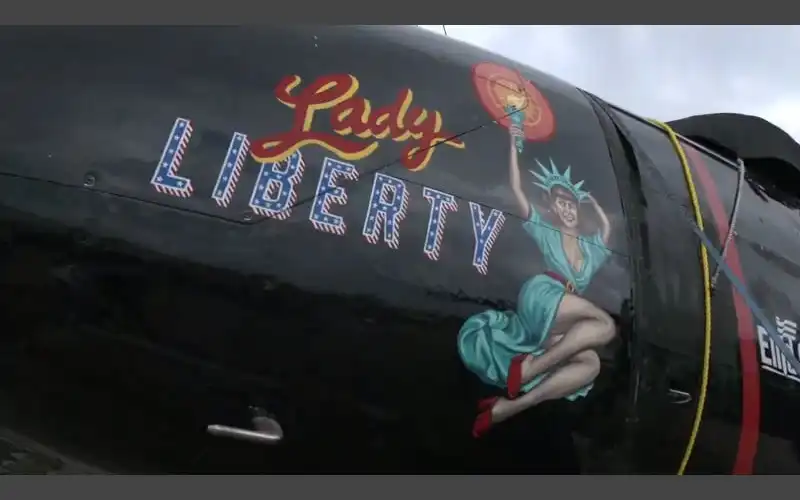
PONCA CITY, Okla. –After decades of combat and years spent flying in the Commemorative Air Force, the Douglas A-26 Invader known as “Lady Liberty” is beginning a new mission. Volunteers and aviation experts spent Friday in Ponca City carefully disassembling the World War II aircraft so it can be transported to the Tulsa Air and Space Museum, where it will be preserved as both a piece of history and an inspiration for future generations interested in aviation and STEM careers.
A combat veteran with an extraordinary history
Built toward the end of World War II, Lady Liberty represents an important evolution in military aviation.
As the war continued, the United States needed an aircraft that was easier to operate and required fewer crew members than earlier bombers. The Douglas A-26 Invader became that answer. It could attack targets from the front while also delivering bombs and would go on to serve in three wars.
“This particular A-26 flew during World War II, during the Korean War and during the Vietnam War,” said Tonya Blansett, Executive Director of the Tulsa Air and Space Museum. “So she is a combat veteran.”
Although it was originally built in Long Beach, California, the aircraft has ties to Oklahoma’s history.
“But she represents all of the other A-26s that were built in Tulsa during WWII by Tulsa’s workforce — by Tulsa’s own Rosie Riveters,” Blansett said.
Retired Air Force Lt. Col. Kenneth Craib said Lady Liberty reached Europe in 1944 and, to the best of his knowledge, was the oldest flying A-26 before a crash last year ended her flying days. He called her “a true WWII veteran.”
Taking apart 82 years of history
Moving Lady Liberty to Tulsa is no simple task.
Crews first had to remove the aircraft’s wings — a painstaking process made even more difficult because some of the hardware had not been touched since it was put on in the 1940s.
“They haven’t been removed in 80 years, so they’re being a little bit difficult,” one volunteer said. Another added, “We’ve taken them apart before, but not like this… it’s stuck.”
Inside the aircraft, volunteers worked to free large pins and bolts.
“They’ve been in there since 1944,” volunteer Paul Backhaus said as crews slowly loosened each piece.
Despite the challenges, no one seemed frustrated. Instead, many viewed the careful work as another way of honoring the airplane’s remarkable life.

More than an airplane
For the people who have flown, restored and maintained Lady Liberty, the aircraft has become something much more than metal.
“Everybody who’s ever had a piece in this, who’s stepped onto the aircraft or touched the aircraft, they leave a little piece of themselves behind,” said Henry Klempan, Unit Leader of the Lady Liberty Squadron. “The machine takes that as kind of her collective soul.”
Klempan said disassembling the aircraft has been emotional.
“We feel like we’re hurting the machine,” he said. “Every step of this has hurt.”
He said the maintenance director has even spoken to the airplane before beginning work, promising, “We’re gonna do the best we can take care of ya.”
The attachment is understandable, Klempan said, because Lady Liberty protected those who flew her. When the plane crashed just before takeoff in 2025, no one was injured.
“The flip side of that is she took care of us.”

A crash ended one mission but started another
Lady Liberty’s flying career came to an end after a crash last year.
“They were definitely shaken up, and their hearts were broken,” Blansett said. She noted the aircraft can no longer fly but said its impact is far from over.
The museum believes preserving the aircraft will allow it to continue serving in a different way.
“She’s now entering a new chapter of her life where she will join our collection at the museum and inspire our future workforce in Oklahoma,” Blansett said. “She may not fly anymore, but she’s going to soar in the minds of the youth.”
A new home in Tulsa
Once crews finish removing the wings and loading them onto trucks, Lady Liberty will make the trip from Ponca City to the Tulsa Air and Space Museum.
The museum plans to begin reassembling the aircraft in Tulsa, where visitors will be able to see not only a rare World War II combat aircraft but a symbol of the men and women who built it, flew it and continue working to preserve its legacy.








