







COMANCHE COUNTY, Okla. –State Farm has complied with an Oklahoma judge’s orders to release internal documents that attorneys representing homeowners across the state believe prove a scheme to underpay on weather damage claims.
Why this matters
Insurance regulators and courts have generally held that a claims department is supposed to evaluate what’s owed based on the policy and the damage, not based on internal savings targets.
These documents, according to the lawsuit, show State Farm running its wind and hail claims process more like a cost-cutting sales campaign, complete with quotas, tracking dashboards, and internal messaging control, while telling customers nothing had changed about their coverage.
How we got here
This release of State Farm’s internal documents came after Comanche County District Judge Grant Shepherd ordered the company to release them during an August 2026 hearing in the case of Neil and Lacy West, case No. CJ-2025-135.
Oklahoma State Farm Lawsuit Heads To Comanche County Hearing
The Wests’ case is one of many lawsuits against State Farm in Oklahoma, alleging an internal plan to reduce payouts for weather damage claims.
Earlier in August 2026, Oklahoma County Judge Amy Palumbo ordered State Farm to comply with ongoing requests to release documents and to produce executives for deposition in a separate case filed by homeowners Billy and Lacy Hursh, case No. CJ-2025-2626.
The Hursh lawsuit is the same suit Oklahoma Attorney General Gentner Drummond tried to join, but the Oklahoma Supreme Court ruled that he could not intervene. This led Drummond to file his own lawsuit against State Farm in Cleveland County in July 2026.
What do the State Farm documents released in Oklahoma show?
1. It started as a “biggest bucket of opportunity.”
Where this is in the documents: (Exhibits 3,4,5)
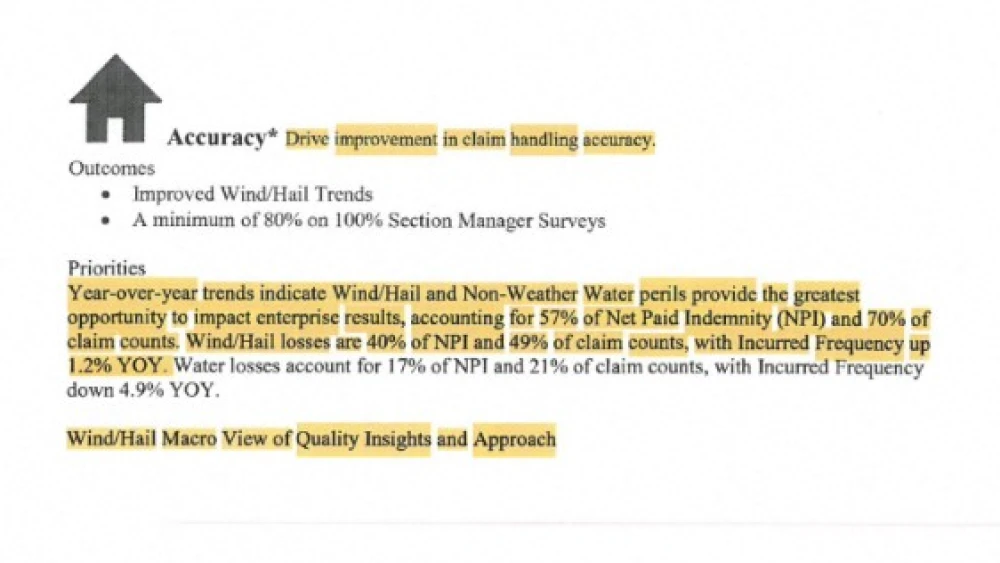
What the exhibit shows: Internally, State Farm identified full roof replacements as the single largest area where it could cut costs.
One executive, Nicole Manduca, wrote plainly that this “biggest bucket” meant savings on what the company pays out to policyholders.
A 2020 planning document put a number on it: roof claims made up 57% of what State Farm was paying out — making it the company’s top target.
2. State Farm built a playbook and rolled it out nationwide.
Where this is in the documents: (Exhibits 9, 10, 23, 27, 28, 30 and 31)
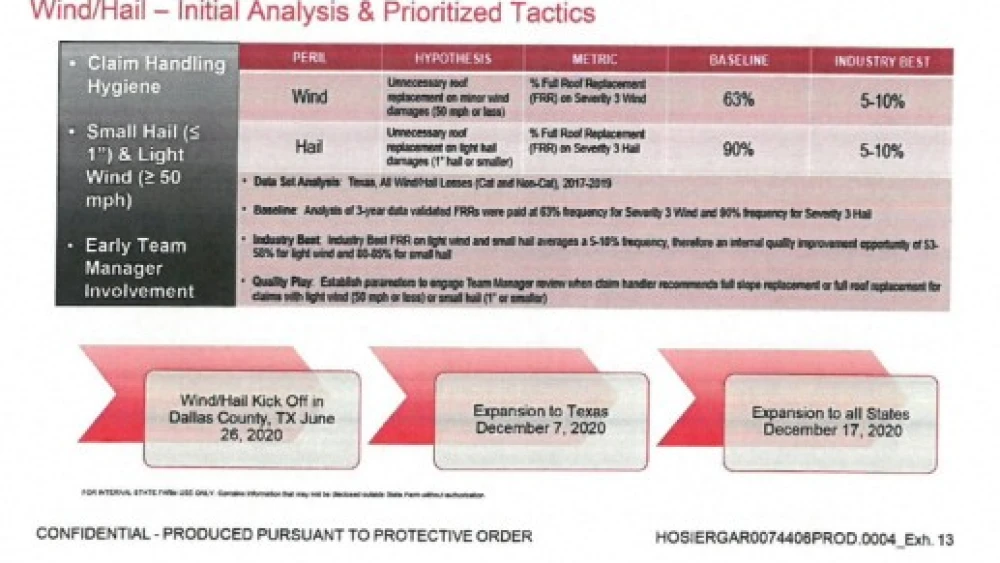
What the exhibit shows: Starting with a “kickoff” in Dallas County, Texas, in June 2020, the tactics expanded to all of Texas by December, then to every state by the end of that year.
The documents lay out the specific tools used to get adjusters to approve fewer full roof replacements and more “repairs” instead:
- A “Roof Skills Review” and mandatory refresher training
- A training module called “Art of the Conversation” — essentially, a script to help adjusters and agents deliver bad news to customers without changing the actual insurance policy
- Extra manager sign-off required before a roof replacement could be approved — but not before a claim was denied or downgraded to a repair
- Weekly tracking of how often roof-replacement decisions were being “overturned” to repairs instead
- A dedicated internal team — the “Hail Reconciliation Unit” — whose job was to review and reverse roof-replacement recommendations
3. State Farm measured it like a sales campaign.
Where this is in the documents: (Exhibits 2, 6, 7, 10 and 30)
What the exhibit shows: Executives discussed “how we’ll know the tactics are working” and tracked the ratio of full roof replacements to partial repairs. According to the documents, that ratio was cut by more than half after the rollout.
One executive, Tom Moss, did the math out loud in an email: each percentage-point drop in approvals was worth roughly $78.8 million a year, based on an average savings of about $15,769 per denied or downgraded claim.
4. State Farm bragged about the results.
Where this is in the documents: (Exhibits 6, 7, 8 and 10)
What the exhibit shows: A 2021 internal document credits the tactics with a $1.4 billion drop in claims payouts in just the first year. One executive described a new internal tracking dashboard as a “silver platter” handed to the team running the program.
5. There was outside pressure to make the numbers look legitimate.
Where this is in the documents: (Exhibits 4, 10 and 30)
What the exhibit shows: State Farm hired Accenture to help develop industry benchmarks suggesting insurers overpay on wind and hail claims, benchmarks the documents describe as self-serving, built to justify the internal cost-cutting rather than to reflect independent, objective standards.
6. State Farm’s own agents were sounding the alarm the whole time.
Where this is in the documents: (Exhibits 1, 17, 18, 20, 22 and 23)
What the exhibit shows: A State Farm agent, Tracy Haus, emailed company leadership directly, warning that the company’s reputation was collapsing because of how roof claims were being handled. She wrote that customers were being lowballed, that adjusters were being pushed to write repair estimates instead of replacements even when replacement was clearly warranted, and that even competitors known for bad claims service — like Allstate — now had a better reputation than State Farm in some markets.
Other internal documents describe agents as “distrustful” of the company and note a “larger than normal number of complaints.” Leadership’s response, per the documents, was to keep running the same program.
7. There was a repurposed “Profit Task Force” discussing claims.
Where this is in the documents: (Exhibits 14, 15 and 16)
What the exhibit shows: Internal emails show a group originally focused on profit strategy was repurposed to meet weekly specifically to discuss claims-handling numbers, a detail that undercuts the industry’s usual defense that claims departments are walled off from profit pressure.
State Farm disputes those allegations and says it evaluates each claim individually based on the damage and terms of the customer’s policy.
What’s next?
Trials are set in November and December on two lead cases.
State Farm executives have been ordered to be deposed by lawyers from Whitten Burrage, including CEO Jon Farney. Attorney General Gentner Drummond has made that firm co-counsel in the State Farm cases.
Further, Oklahoma County District Judge Amy Palumbo will hear a similar motion to make public documents in the Hursh case September 1st.
More State Farm lawsuit coverage
State Farm ordered to produce key documents, executives for depositions in Oklahoma insurance lawsuit
Oklahoma judge orders State Farm to release internal documents amid legal battle
Hot Seat: Oklahoma Supreme Court Ruling Could Make State Farm Documents Public
Oklahoma Supreme Court Denies Attorney General’s Intervention in State Farm Case, Opens Door for New Lawsuit
Drummond files lawsuit against State Farm; accuses insurance company of wrongfully denying claims









