











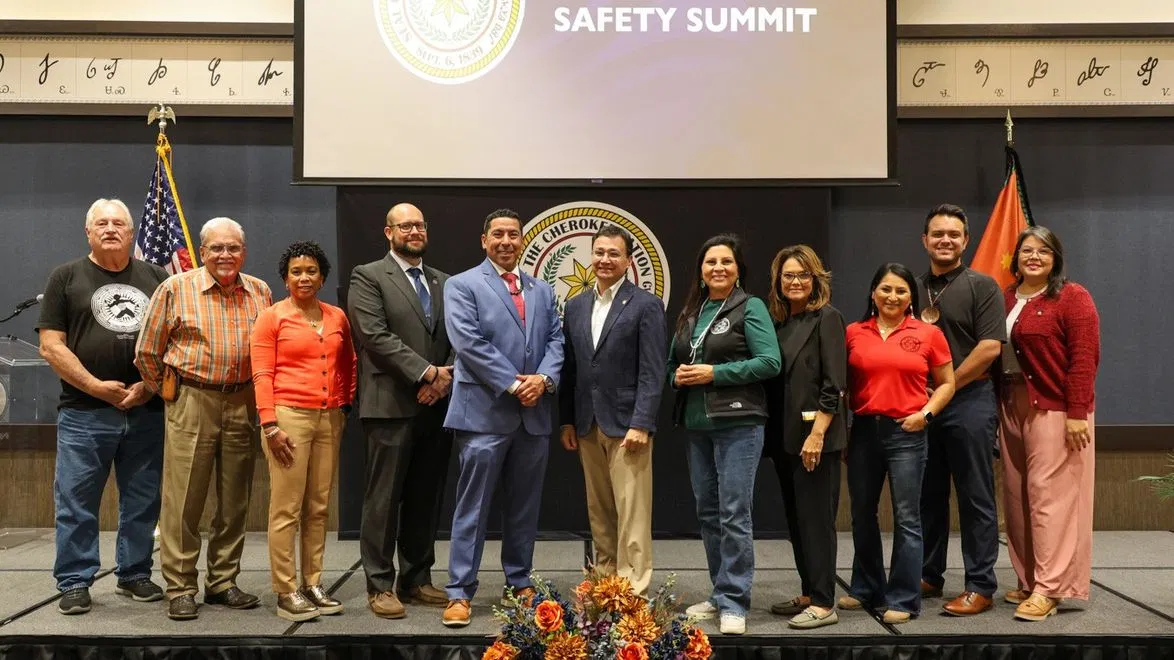
Principal Chief Chuck Hoskin Jr. announced the initiatives Wednesday during the Marshal Service Safety Expo at the Chota Conference Center.
The $10 million siren project will address gaps in outdoor warning coverage at 260 locations across the reservation. The tribe received an $8 million Next Generation Early Warning Systems Grant from the Federal Emergency Management Agency and will contribute up to $2 million in tribal funding through the Public Health and Wellness Fund Act.
Engineering analysis and coverage modeling identified areas where residents have limited, inconsistent or no access to outdoor warning systems. Once the proposed sirens are installed, an estimated 261,180 residents will fall within their coverage areas.
“Severe weather is a fact of life in northeastern Oklahoma, and every family on the reservation deserves to hear the warning when danger is headed their way,” Hoskin said. “Cherokee Nation has a responsibility to prepare for emergencies before they happen. With this $10 million initiative, we are closing critical gaps so more people receive potentially lifesaving warnings when storms threaten our communities.”
Cherokee Nation will work with county and municipal governments and emergency management agencies on the project. Local governments will retain ownership and responsibility for maintaining, operating and activating their respective warning systems.
Deputy Chief Bryan Warner said the project is based on an analysis of population locations and existing coverage gaps.
Cherokee Nation Marshal Daniel Mead said expanded outdoor warning coverage will provide another way to alert people who may be outside, traveling or away from their phones when severe weather approaches.
Cherokee Nation Procurement will soon open a bidding process for all 260 proposed sites. The bids will include outdoor warning equipment, site infrastructure and construction services.
In addition to the siren initiative, Hoskin announced $3.1 million for the Housing Authority of the Cherokee Nation’s residential storm shelter program.
The funding is intended to address a backlog of applications from low-income Cherokee elders and citizens with disabilities who live within the reservation. It will also allow the housing authority to accept new applicants during the current fiscal year.
Of the $3.1 million, $1.6 million in existing Housing, Jobs and Sustainable Communities Act funding will cover a recent bid for 200 residential storm shelters.
Another $1.5 million in new Public Health and Wellness Fund Act funding will be used to address the program’s remaining waiting list, with additional funding available to accept new applications.
The housing authority will begin working through the waiting list using the new funding. Hoskin said tribal funding is also available through the Housing, Jobs and Sustainable Communities Act to continue building storm shelters each year for eligible low-income elders and citizens with disabilities living within the reservation.
The Housing Authority also offers an alternative through its I-Save program, which provides a four-to-one savings match for eligible housing rehabilitation projects, including residential storm shelters. Applicants must meet income and residency requirements.









