











CONCHO, Okla. –
Cheyenne and Arapaho tribal citizens voted Saturday to impose a three-year moratorium on data center construction on tribal lands.
During the tribal meeting, the floor was opened for anyone to speak about the topic. The primary concerns related to environmental, economic and transparency issues.
Key Takeaways
- Cheyenne and Arapaho tribal citizens voted Saturday for a three-year moratorium on data center construction on tribal lands.
- Of 351 votes cast, 261 supported the moratorium, 83 opposed it and seven abstained.
- Tribal citizens raised concerns about water use, environmental effects, potential economic benefits and transparency surrounding future data center proposals.
- Cheyenne and Arapaho Gov. Reggie Wassana said no data center agreement has been signed and said any potential project would undergo further study and community discussion.
Environmental Concerns
“We have a spiritual responsibility because we are Cheyenne and Arapaho people and our traditional values respect this water of life,” said Kyle Spotted Horse, a member of the Cheyenne and Arapaho tribes.
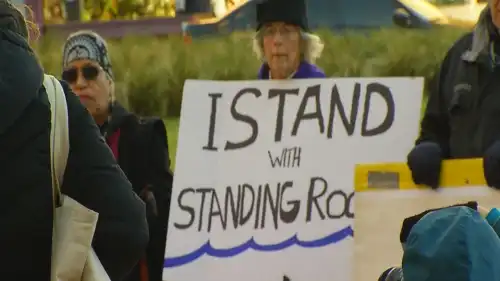
He brought up Mní Wičóni at Standing Rock, the location of a protest against an oil pipeline that crosses Sioux land in the Dakotas.
In 2016, a vocal protest against the Dakota Access Pipe Line took place, creating the Mní Wičóni movement to protect water and tribal lands. Spotted Horse said a data center would require 300,000 gallons of water per day, adding up to 100 million gallons per year.
RELATED: Oklahomans Gather In Downtown OKC In Support Of Standing Rock Sioux Tribe
“Until we adjudicate our water rights, how do we move forward with such a massive amount of consumption of water?” Patrick Kincaid said. According to Oklahoma State University, water right adjudication is the process through which groups can establish who has ownership of which bodies of water.
“You know what would be a dealbreaker for me is that through this whole process, there is 100% transparency. No NDAs and a full impact study, especially on our buffalo,” said another woman. “We’ve spent years building our herds. How will this affect our buffalo herd? And as good neighbors, what impact will this have on surrounding farms and farmland and animals? I want us to be informed all along the way.”
Damon Dunbar raised the question of fracking and its comparable water usage to a potential data center.
“They’re draining Canton Lake right now to feed Oklahoma City. That’s not funny, that’s very deadly. We’re not going to be having anything. We’re going to be looking like south Texas or the desert.” Another man was concerned about the effects of drought and further water usage on the community and environment. “I don’t get up and say much at these meetings, but this part is very important,” he finished, a sentiment echoed by another speaker.
“Water is our way of life. If we don’t protect our lands, who’s going to? If we don’t stand up for our kids, who’s going to?” A woman said, supporting the moratorium.
RELATED: How much water does AI really use?

Governor’s Response
Governor Wassanna responded to these concerns, saying a potential data center would use a closed loop system, challenging earlier estimates of 300,000 gallons of water per day being used.
“The water usage has developed to where there’s little to none except filling it up because it’s a closed loop,” he said. Wassanna further clarified that data centers are now capable of using cooling coils which do not use as much water as previous facilities. “It won’t be 300,000 gallons a day. Actually, cities use more water on their golf courses than people would actually use probably for data centers.”
Economic Concerns
“I feel like it’s the old days of the old cattle barons, oil barons, people wanting to exploit our resources, snake oil salesmen,” Spotted Horse said of the economic impact of a potential data center. He questioned who would receive the profits from the facility.
Governor’s Response
“Data centers are huge profit making projects. They make over $1 billion a year. 20%, 30%, $200 million. Somebody told us the other day, ‘Reggie, we make $90 million a day.’ $90 million a day,” said Wassanna. “If you want to look at the tribe’s share, you look at elders, you look at per cap, you look at housing, renovations, all these things we talk about that we’re hurting. Food, gas, these things.”
Wassanna further stressed that if a data center was built on tribal lands, those in the Cheyenne and Arapaho tribes wouldn’t have to worry about financial issues.
“You’d be comfortable, the most comfortable tribe around in western Oklahoma.”
Transparency Concerns
“We have a responsibility not only to ourselves and this water and Mother Earth, but we also have a responsibility to our community. How many have heard about Yukon voting out their mayor because he did an NDA? Kudos to them for doing that,” Spotted Horse said in reference to the recent recall motion against Yukon mayor Brian Pillmore in Aug. “How would they feel if we just ripped right behind their back in their backyard and did our own thing, potentially causing water pollution, air pollution, not to mention electrical grid cost impacts.”
“If we make this decision today, in 3 years, we’ll have a better idea of how this is going to impact our future, our children,” said a woman named Vera. The moratorium would halt any data center construction for three years.
Governor’s Response
“I just want to say something. Before, there was going to be community meetings. This resolution came up, but there was going to be community meetings. Nothing’s been signed, there is a feasibility study that was going to be done. The legislators all acknowledged it. We ain’t done nothing yet. This is up to you guys to say yes or no.”
RELATED: What are data centers? Why are so many people against them?

“Vote however you want, but the future is coming,” Wassanna said. “Technology is evolving. Where are we going to go with it?”
After the speakers were finished, 351 people voted out of the eligible 478. The final vote was 261 for the proposal, 83 against and 7 abstentions.
The resolution sets a moratorium until October of 2029.









