











WASHINGTON –
U.S. Sen. James Lankford is renewing his push to prevent government shutdowns as Congress faces another funding deadline this fall.
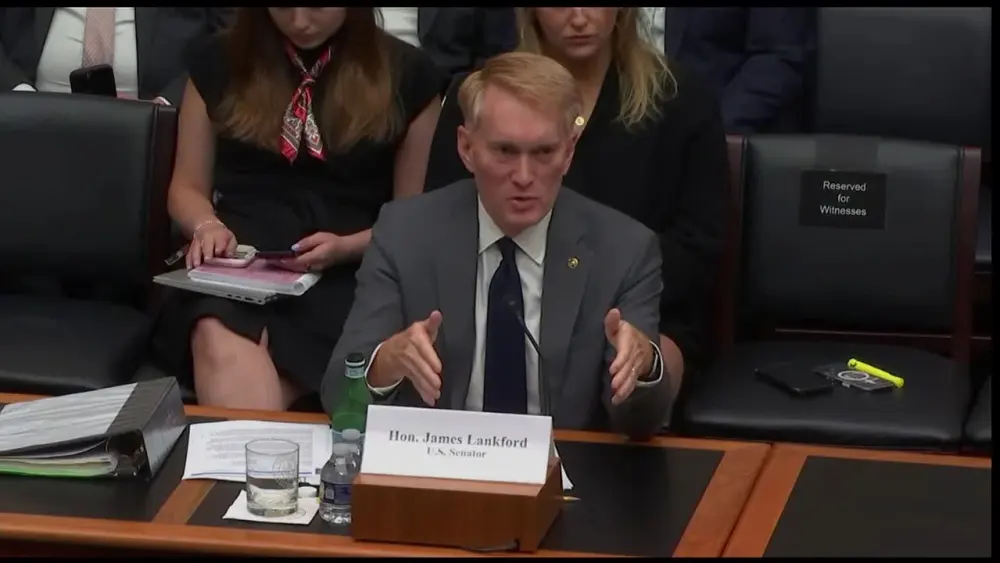
During more than three hours of testimony before a House committee, Lankford argued lawmakers, not federal workers, should bear the consequences when budget negotiations stall.
His proposed Prevent Government Shutdowns Act would require Congress to remain in session until appropriations bills are passed, instead of allowing shutdowns that leave federal employees without pay.
Lankford joined News 9 on Thursday to share more about his proposal and other efforts by Oklahoma’s congressional delegation.
Let’s talk about your bill. Explain what it would actually do.
Lankford: So we’ve had so many government shutdowns since the 1980s. That’s when all this started, and just gotten worse and worse and worse. I’ve fought to try to get these to stop because they just affect so many federal workers and their families and all of us that try to be able to reach out to different federal agencies and just get an answer, and you can’t get an answer. It’s a pretty simple, straightforward answer. It’s what my school teacher mom would have said. If you don’t finish your work during class, you’ve got to stay after class. The most straightforward way to do this is if the appropriations work is not done, then Congress has to remain in session seven days a week. You can’t do anything other than appropriations, and we all have to remain here in negotiation until the work is done.
Now, when shutdowns happen, federal workers are the ones that are punished. Their pay is cut off. But then members of Congress just go home and like nothing ever happened. Well, something has happened. It’s happened to all those folks that just got their pay cut off. So the Senate has already voted to stop our pay during a government shutdown. But that doesn’t help those federal workers who are also not getting paid. They want to get paid for the job. So this just keeps us at the task until the job is done and holds everyone else harmless.
Government shutdowns are something that both parties have used as a political football of sorts. Do you see them giving up that power of using a shutdown as leverage if you’re in the minority party?
Lankford: Yeah, this is the challenge in Washington, DC. The only thing worse than the status quo is changing the status quo in Washington, DC. It’s always this challenge of, “Well, it could be worse,” or, “There could be some unintended consequences, so we’ll leave it as it is.” The House hearing that I had yesterday, multiple members came back to me and said, well, I don’t want to have an automatic continuing resolution. It may take us longer to get to a resolution. But what they’re basically saying is, I like keeping the pressure on all these federal workers, but not having the pressure on us. So I continue to be able to push back over and over again and said, “Why are we punishing federal workers [who] are not at the table negotiating?” All the pressure should be on the negotiators to actually get the job done.
Regarding the SAVE Act. What are your thoughts on where it stands this morning?
Lankford: Yeah, it’s technically called the SAVE America Act, and I’ve been a co-sponsor of that act from the very beginning of this. This should be common sense stuff just to be able to protect our elections, and I know there’s a lot of emotion around it, but in Oklahoma, we already have voter ID. 36 states have voter ID. This bill is about getting the other 14 states to have voter ID, the same as we do in Oklahoma. It’s also about verification of citizenship, that when you register to vote, you’ve got to show you’re a citizen. It’s not a crazy idea. Even the state of New Hampshire does that. Arizona does that. This is already done in parts of the country. We just had a release from New Jersey just this week where they said, “Oops, we just found that 400 people who are not legal in the country,” we allowed them to register to vote, and they voted in New Jersey elections, even in federal elections. That’s against federal law. But right now, the issue is not whether it’s against federal law. It’s that we don’t do any verification of that until after it’s over. So we need to be able to have not just trust, but trust and verify. That’s what this bill tries to do.
Senator, it could mean getting rid of the filibuster to get this passed. There doesn’t seem to be a lot of appetite for that. What are your thoughts? Is it possible that the SAVE America Act could end up getting passed?
Lankford: Well, we’re gonna continue to work to get it through, I voted for it six times already. We continue to be able to push it. We continue to be able to debate, but let me be really clear. I’m not for nuking the filibuster. I would tell you, four years ago, my Democrat colleagues, when they ran the Senate, and they had the House, the Senate, and the White House, they tried to get rid of voter ID for the entire country, literally take voter ID away from Oklahoma. I was able to block that because I was able to filibuster them. Oklahoma would not have voter ID right now if the filibuster were gone. So, yes, the filibuster is hard. It’s frustrating. It slows the process down. But it forces grownups to have to talk to each other and to be able to work out our differences. I’m not willing to be able to give that up and to throw away centuries of history in the Senate to be able to get this when I know that when Democrats come back, they’ll immediately use that power to take away all voter ID from our state and from other states. So let’s just keep talking and debating this out and not try to blow up the structure.
In recent news, three U.S. service members were killed in the war in Iran, and a fourth is still considered missing. Do you see the war with Iran ending anytime soon?
Lankford: We all prayed, and so none of us wanted to have a war in the first place with Iran. We’re all looking forward to this ending as soon as possible. This [has been building] over five decades now. Iran has attacked the United States with its terrorist proxies hundreds of times over the past several years, even. Before this war actually started, Iran was already attacking us in the region, attacking our shipping, attacking Americans who work in that region. So this has been an ongoing issue for a long time. President Trump has spoken out very, very clearly that Iran cannot have a nuclear weapon.
When you’ve got a terror state that is literally trying to terrorize not only the United States and Israel and the United Arab Emirates and Jordan and the whole region, imagine what they would do with a nuclear weapon if they had it. So they cannot have that, and President Trump has determined they’re not going to have that. They can’t continue to terrorize American citizens as they have done by the hundreds of times, and they’ve got to open up their free flow of commerce in that area. It is affecting our economy and the economy of the entire world. This has been something they’ve threatened or done over and over again. This can’t be done on it, and by the way, I do feel for the people of Iran. This is not an issue of the people of Iran. This is the regime that oppresses and murders them as well as attacks their neighbors. So this is a real challenge and is not simple to be able to solve.








